


Skip to product information


$34.00
What role this tool plays
This is not a storage pouch.
This is the containment boundary
that prevents failure from spreading through your bag.
Without this boundary,
small problems do not stay small.
This pouch creates a single, contained unit
for items that would otherwise move, leak, or scatter.
Instead of managing individual bottles or small items,
it allows them to be handled as one group.
This keeps interactions contained within a single unit,
reducing the need to move or expose surrounding items.
Why this role matters
Most issues during travel are not caused by the items themselves.
They happen when:
liquids leak into surrounding space
small items spread across the bag
contents need to be checked or removed under time pressure
Without containment, a small failure expands.
This tool limits that expansion.
This tool is what defines where that expansion stops.
Without it,
there is no clear boundary in the system.
What conditions matter
For this role to work, several conditions matter.
Required
Contents can be seen without opening
The pouch can be removed as a single unit
Materials tolerate contact with liquids
Opening allows full access without emptying everything
If these are not met,
the pouch cannot function as a containment boundary.
Most generic pouches fail here.
They store items,
but they do not define a boundary.
Optional
Structure holds its shape inside the bag
Zippers operate smoothly with one hand
Color or form allows quick recognition
Specification
Size
Approx. 6.25 x 6.25 x 2.5 inches (quart size)
Material
Clear PVC with reinforced stitching
Closure
Dual zipper with clamshell-style opening
Structure
Soft but slightly structured when filled
Capacity
Fits multiple travel-size (≤100ml) containers
Other Features
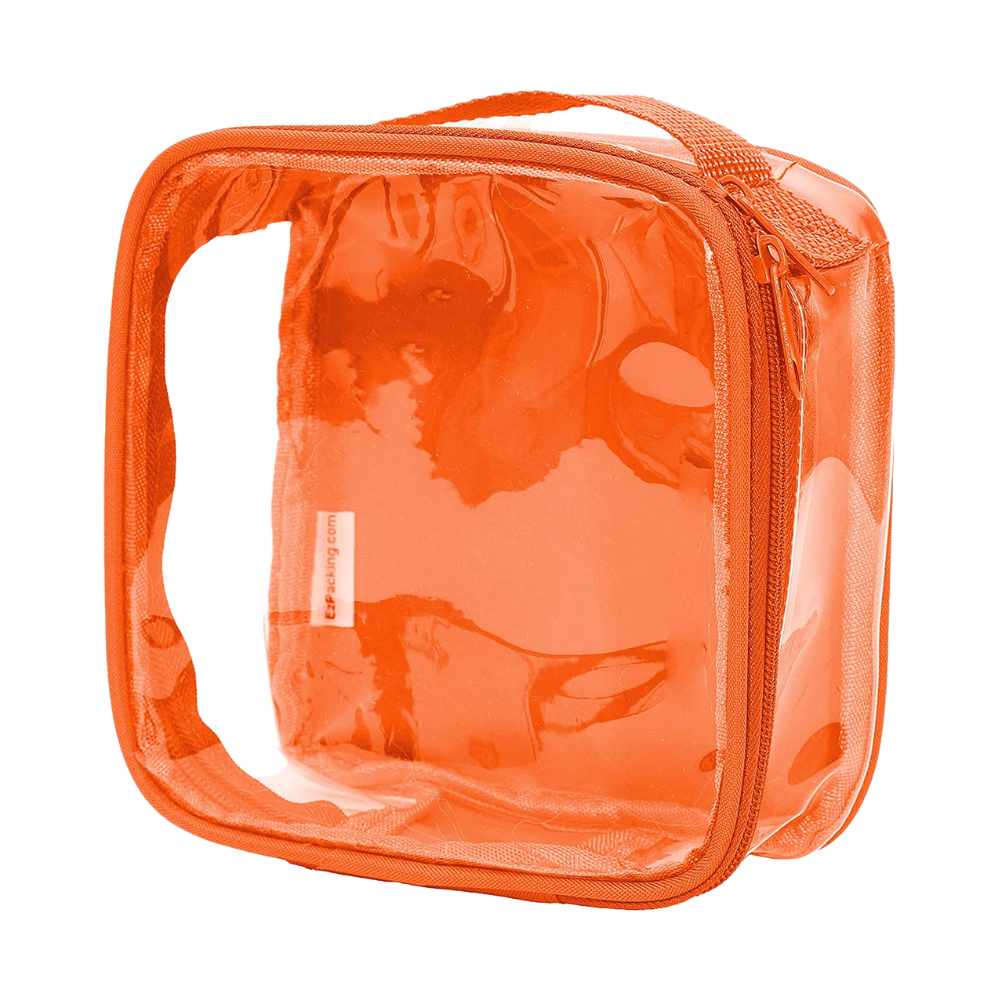
Transparent body for visibility
Carry handle for quick removal
How to interpret these specs
Each feature affects how the pouch behaves during use.
Clear material
→ contents visible without opening
→ reduces inspection time and searching
Clamshell opening
→ full access without removing everything
→ prevents unnecessary movement
Dual zippers
→ controlled opening/closing
→ lowers chance of accidental exposure
Soft structure
→ adapts to bag space
→ but does not isolate pressure by itself
What typically goes inside
This pouch is commonly used to hold:
travel-size liquids such as shampoo, lotion, or sunscreen
small toiletry items that tend to move independently
items that may leak or leave residue
grouped essentials that need to be handled together
These items typically appear in the following situations.
Where it fits best
This pouch works best in situations where:
multiple small items need to be handled together
contents must be shown or checked quickly
Because of this, it is typically placed
in an upper or easily accessible layer of a bag.
separation between items matters
small failures (like leaks or spills) need to stay local
Placement in a setup
This pouch is typically placed:
in a separated zone away from clothing
near the top layer for quick access during inspection
in a position where it can be removed without unpacking the bag
Example system fit
In the Leak Prevention System
This pouch functions as a secondary containment layer.
It does not stop leaks at the source.
Instead, it ensures that when a leak occurs:
it remains inside a defined boundary
it does not affect clothing or other items
cleanup stays limited to a single unit
In this system, it sits outside the primary containers
and defines where failure is allowed to exist.
Limitations
This pouch is not designed to prevent leaks on its own.
It is not fully waterproof under pressure
It cannot replace leak-resistant containers
Sharp or rigid items may affect durability over time
Its role is containment, not prevention.
When this is enough
This pouch is sufficient if:
You are already using leak-resistant containers
You need to group items into a single removable unit
You want to limit how far small failures can spread
You do not need additional containment layers if:
You are not carrying high-pressure liquids
The pouch is not placed under sustained compression
If these conditions apply,
this pouch can function as a complete containment layer in your setup.
How many to use
One pouch is enough for basic use.
Multiple pouches can be used to:
separate liquid and non-liquid items
isolate higher-risk contents
create smaller, more controlled units
Related system uses
Currently
Leak Prevention System
Planned extensions
Security Flow System → inspection unit
Tech Flow System → cable grouping
Access Priority System → quick-access bundle
Across these systems, the role remains consistent:
to create a defined, removable unit
that limits how far movement or disruption can spread.
Final
If your setup still depends on
keeping everything perfectly sealed,
this pouch will not resolve the issue.
If your system breaks when one thing goes wrong,
it is not because of the item.
It is because there is no boundary.
This pouch is that boundary.
You do not need a better item.
You need a place where failure stops.